Routines: start small, stay reliable
Six templates for short sequences and the freedom to make them yours.
Why routines?
Good days are the foundation for hard moments. If you spend a few minutes with yourself in the morning and evening, you have something to hold on to when it counts.
Routines in Anker are short on purpose. They should feel like support, not like duty.
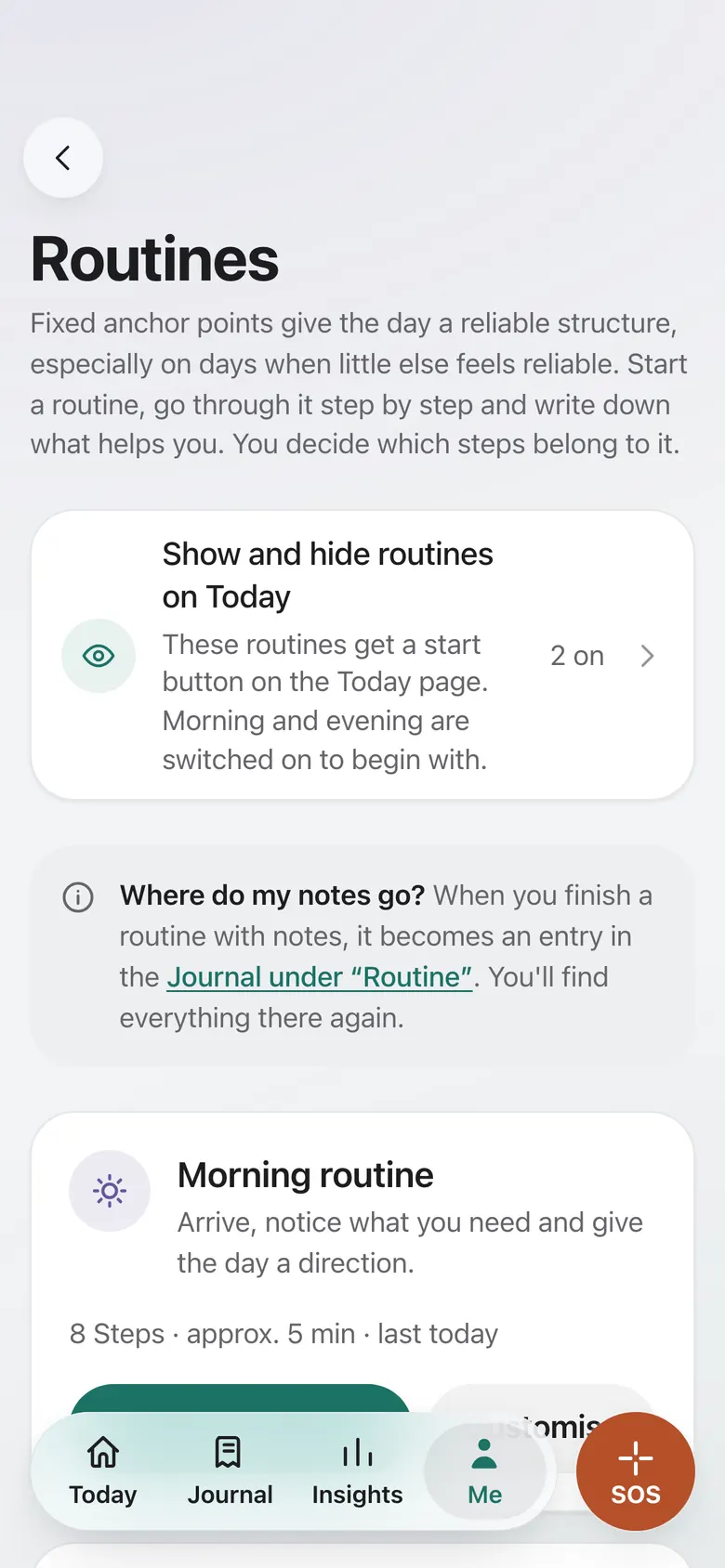
The routines
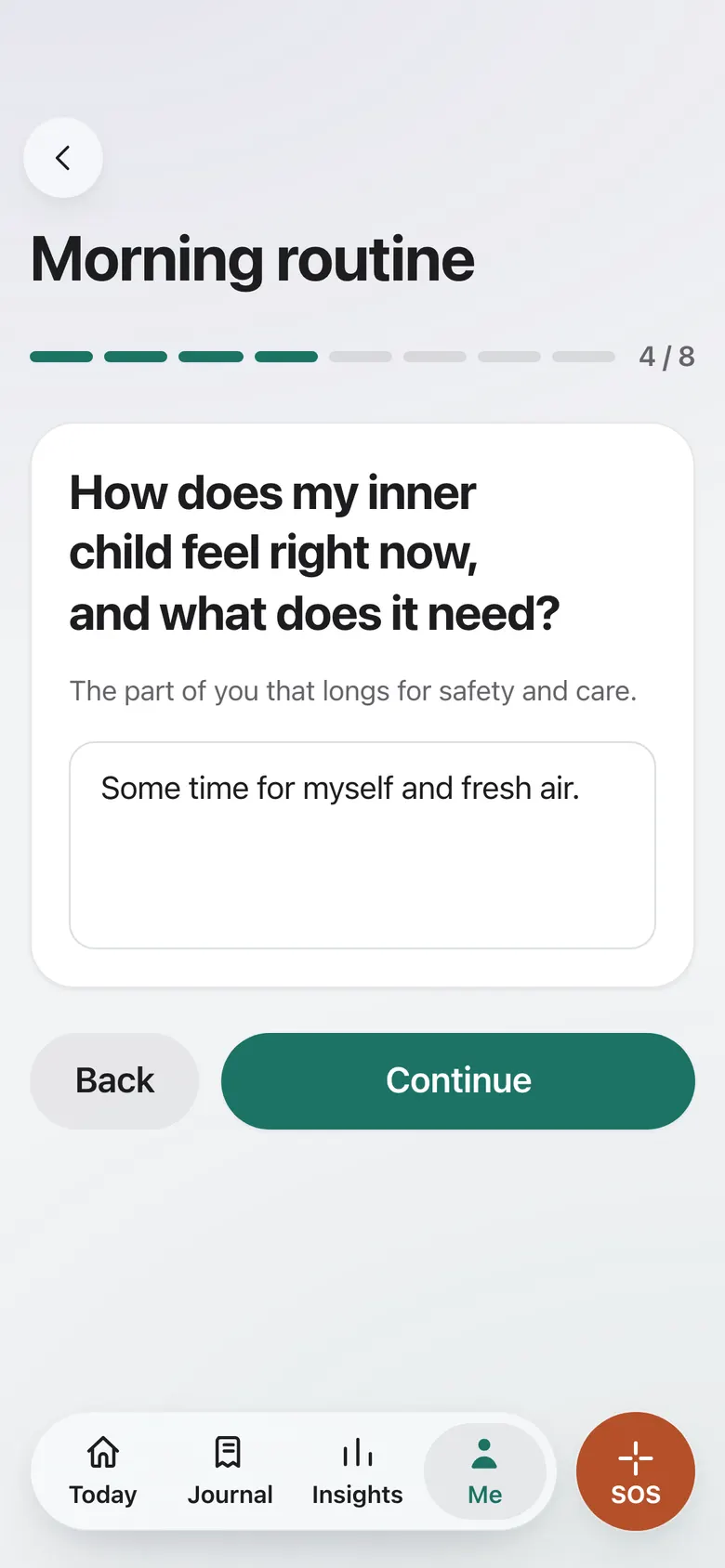
One step of a routine


What routines do
Six templates
Morning routine (about 5 minutes), Evening routine (about 8), Inner child (about 10, guided), Self-compassion break (about 4), Body check (about 5) and Weekly review (about 10).
Steps to fit you
Every step can be switched on or off, reordered and supplemented with steps of your own. You can also create routines entirely of your own.
Questions or read-along texts
A step is usually a short question to write down or a text to read along.
Mood and feelings
Morning and evening routines also ask about mood and feelings: a slider with five levels, where colour and shape show how it feels, and feelings to tap, as in the journal. Both are voluntary, appear at the top of the routine entry and count in Insights under “From your journal”.
Notes in the journal
You finish a routine with written steps as soon as you have written or chosen something in at least one step. Your notes land as a routine entry in the journal. The evening gratitude step also counts as a gratitude entry.
Start from Today
Morning and evening routines appear on Today by default. You set which ones show up there under Me → Routines (“Show and hide routines on Today”).
Keep reading on the blog
Start small. One check-in is enough.
Anker is free and runs in your browser and as a web app. There are no ads, no third-party tracking and no pressure.
If Anker has helped you and you would like to, you can voluntarily support its running and further development. Support Anker